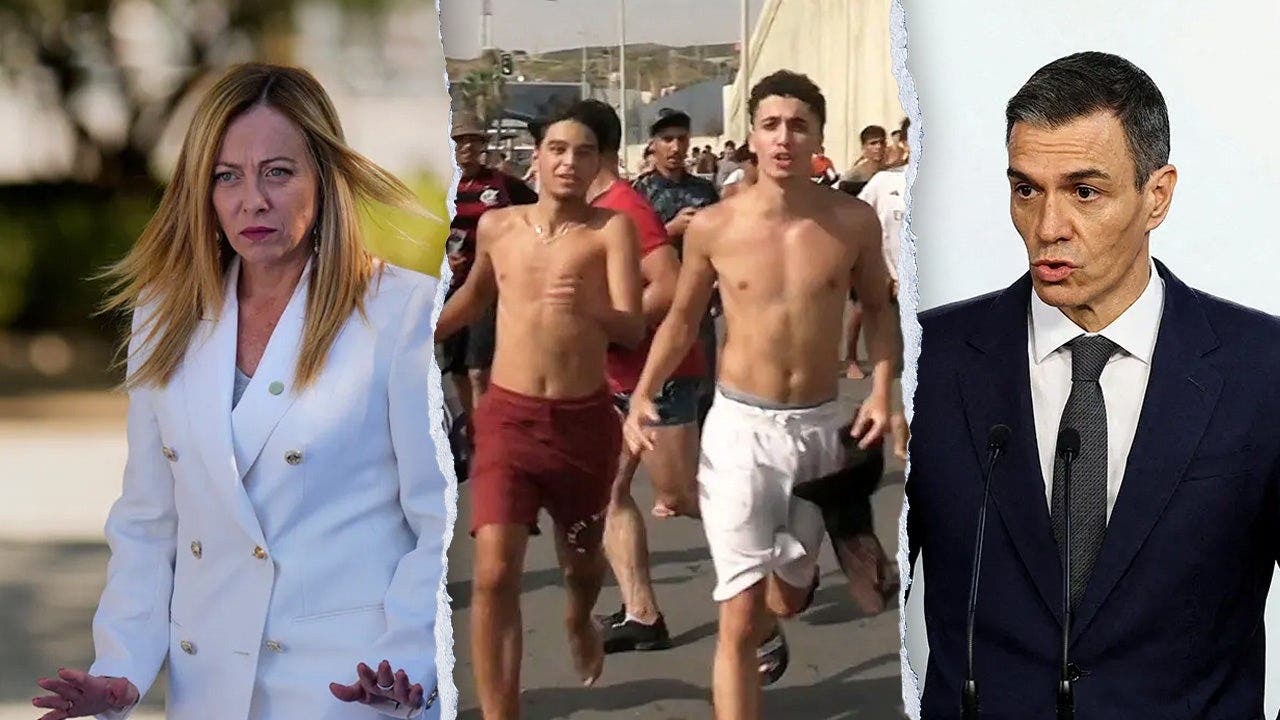
Here's the thing. When 60,000 migrants storm a Spanish border enclave in a matter of days — nearly matching Ceuta's entire population — the normal diplomatic response is not to scold the neighbors who locked their doors.
That is, apparently, not how Pedro Sánchez sees it.
In a letter addressed to European Commission President Ursula von der Leyen and European Council President António Costa, Spain's Prime Minister accused fellow EU leaders of a 'selfish, polarising and unlawful reaction' to the crisis at Ceuta, the Spanish exclave bordering Morocco. The letter, obtained by Agence France-Presse, singled out the decision by Italian Prime Minister Giorgia Meloni to temporarily suspend Schengen Area free-travel arrangements with Spain — an emergency border-control measure Meloni enacted as tens of thousands of migrants overwhelmed the enclave's crossings.
Sánchez argued that the backlash was driven by 'prejudice, fake news, ignorance, or political interest,' and insisted the response violated 'European law, humanitarian law, and the principles of solidarity.' He also called for a formal meeting of all 27 EU interior ministers.
The Spanish PM did offer one concrete defense: his government, he wrote, has 'fully restored control of the border' and returned 'almost all' of the estimated 50,000–60,000 migrants who crossed. He further cited Frontex data claiming Spain operates 'one of the least porous external borders of the European Union,' with irregular entries running at roughly half of Italy's recorded figures between 2021 and 2026.
Meloni was not the only one pushing back. On Saturday, a group of 22 European leaders issued their own letter warning that 'massive and uncontrolled crossings' at Ceuta 'may encourage other attempts of this kind.' The letter stated plainly: 'We cannot allow massive and uncontrolled crossings, the instrumentalisation of migration, or other hybrid threats that create the perception that it is possible to enter the European Union illegally and that an illegal entry can later become a legal stay.'
Von der Leyen, for her part, tried to thread the needle — noting that 'not a single person reached mainland Spain or the rest of the EU' from the Ceuta surge, while calling for 'a lessons learned process' and stronger border coordination.
One detail Sánchez's letter did not address: the crisis arrived in the wake of a Spanish government amnesty scheme that regularized over one million illegal migrants. Critics had warned the program would function as a pull factor. The timing is not a fact Sánchez invented — it is a fact he chose not to mention.
Voltage take: Meloni enforced a border. Twenty-two European heads of government wrote a letter. Von der Leyen called for 'lessons learned.' Sánchez called everyone selfish. The free-movement architecture of the Schengen Area was built on the assumption that external borders would hold. When they don't, the countries that pick up the slack are not the villains in this story — they are the ones reading the changelog that Brussels keeps ignoring.